Public Cloud Vs Private Cloud Vs Hybrid Cloud
Introduction
Cloud computing offers different deployment models to meet the needs of businesses, governments, educational institutions, and individuals. Choosing the right cloud model is one of the most important decisions when planning a cloud strategy because it affects security, performance, scalability, cost, and overall business operations.
The three primary cloud deployment models are Public Cloud, Private Cloud, and Hybrid Cloud. Each model has unique characteristics and is designed for different workloads and business requirements. A startup looking for affordable infrastructure may choose a public cloud, while a financial institution handling sensitive customer data may prefer a private cloud. Many growing organizations combine both approaches by adopting a hybrid cloud strategy.
Understanding the differences between these deployment models helps businesses select the most suitable environment for their applications and data.
What Is a Public Cloud?
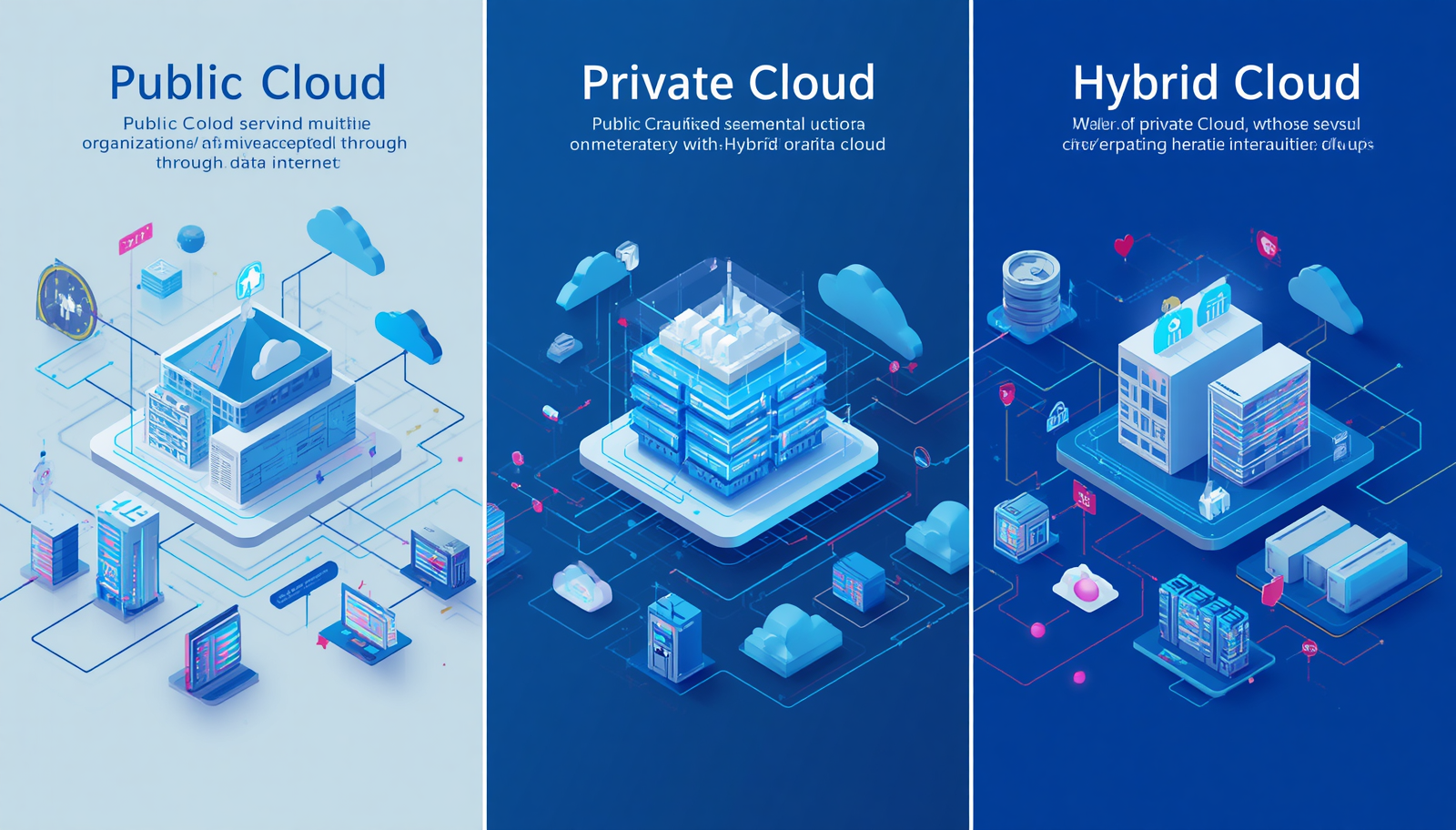
A public cloud is a cloud environment where computing resources are owned and managed by a third-party cloud provider. These resources are shared among multiple customers, but each customer’s data remains isolated and secure.
Users access services through the internet and pay only for the resources they consume.
Well-known public cloud providers include:
- Amazon Web Services (AWS)
- Microsoft Azure
- Google Cloud Platform (GCP)
Public cloud eliminates the need to purchase physical hardware and maintain on-site infrastructure.
Features of Public Cloud
Public cloud provides several important features.
Shared Infrastructure
Multiple organizations share the same physical infrastructure while their data remains separated using virtualization technology.
Pay-As-You-Go Pricing
Customers pay only for the storage, computing power, and services they actually use.
High Scalability
Resources can be increased or reduced quickly according to business needs.
Global Availability
Cloud providers operate data centers around the world, allowing businesses to serve customers from multiple regions.
Automatic Maintenance
The cloud provider manages hardware maintenance, software updates, and infrastructure monitoring.
Advantages of Public Cloud
Public cloud offers many benefits.
Lower Initial Investment
Businesses do not need to purchase expensive servers or networking equipment.
Easy Deployment
Applications and services can be launched within minutes.
Flexible Resource Allocation
Companies can scale resources based on changing demand.
Reduced Maintenance
The provider manages infrastructure, allowing businesses to focus on their core activities.
Suitable for Small Businesses
Startups and small companies can access enterprise-level infrastructure without significant investment.
Disadvantages of Public Cloud
Although public cloud provides many advantages, it also has some limitations.
- Less control over infrastructure
- Shared computing environment
- Compliance challenges in some industries
- Internet dependency
- Long-term costs may increase with higher usage
What Is a Private Cloud?
A private cloud is a cloud environment dedicated to one organization. The infrastructure is not shared with other customers.
A private cloud can be hosted inside the organization’s own data center or managed by a third-party provider.
This model provides greater control over hardware, networking, security, and system configurations.
Features of Private Cloud
Private cloud includes several important characteristics.
Dedicated Resources
All computing resources belong to one organization.
High Security
Businesses implement customized security policies and access controls.
Greater Customization
Organizations configure hardware and software according to their requirements.
Predictable Performance
Dedicated infrastructure provides consistent performance.
Regulatory Compliance
Private cloud supports industries with strict legal and regulatory requirements.
Advantages of Private Cloud
Private cloud provides several important benefits.
Enhanced Security
Sensitive information remains inside a dedicated environment.
Better Performance
Resources are not shared with other organizations.
Complete Control
Businesses manage infrastructure according to their operational needs.
Easier Compliance
Private cloud simplifies compliance with financial, healthcare, and government regulations.
Custom Infrastructure
Organizations choose their preferred hardware, networking, and software configurations.
Disadvantages of Private Cloud
Private cloud also has some disadvantages.
- Higher setup costs
- Hardware maintenance responsibilities
- Requires skilled IT professionals
- Longer deployment time
- Limited scalability compared to public cloud
What Is a Hybrid Cloud?
A hybrid cloud combines both public cloud and private cloud environments into one integrated system.
Businesses keep sensitive workloads in the private cloud while using the public cloud for less sensitive applications, additional storage, or temporary computing resources.
Data moves securely between both environments when needed.
Features of Hybrid Cloud
Hybrid cloud provides several valuable features.
Flexible Workload Management
Organizations decide which applications should run in each environment.
Secure Data Integration
Information moves securely between public and private infrastructure.
Cost Optimization
Businesses use public cloud resources only when additional capacity is required.
High Availability
Applications continue operating even if one environment experiences issues.
Better Disaster Recovery
Critical data remains protected through multiple cloud environments.
Advantages of Hybrid Cloud
Hybrid cloud combines the strengths of both deployment models.
Greater Flexibility
Organizations choose the best environment for each workload.
Improved Security
Sensitive information remains in private infrastructure.
Lower Costs
Businesses purchase dedicated infrastructure only for critical systems.
Better Scalability
Public cloud resources support temporary workload increases.
Business Continuity
Hybrid cloud improves reliability during unexpected disruptions.
Disadvantages of Hybrid Cloud
Hybrid cloud introduces additional complexity.
Some common challenges include:
- More complicated management
- Integration between cloud environments
- Higher planning requirements
- Security policy coordination
- Network configuration complexity
Public Cloud vs Private Cloud vs Hybrid Cloud
| Feature | Public Cloud | Private Cloud | Hybrid Cloud |
|---|---|---|---|
| Ownership | Cloud Provider | Single Organization | Combination |
| Infrastructure | Shared | Dedicated | Mixed |
| Cost | Low | High | Moderate |
| Security | High | Very High | High |
| Scalability | Very High | Moderate | Very High |
| Maintenance | Provider | Organization | Shared |
| Customization | Limited | Extensive | Flexible |
| Performance | Shared Resources | Dedicated Resources | Balanced |
| Deployment Speed | Fast | Moderate | Moderate |
| Best For | Small Businesses and Startups | Large Enterprises | Growing Businesses |
When Should You Choose a Public Cloud?
Public cloud is suitable for:
- Website hosting
- Mobile applications
- Software development
- Testing environments
- Cloud storage
- Startups
- Small businesses
- Online collaboration
When Should You Choose a Private Cloud?
Private cloud is appropriate for:
- Financial institutions
- Government agencies
- Healthcare organizations
- Large enterprises
- Companies handling confidential customer information
- Businesses with strict compliance requirements
When Should You Choose a Hybrid Cloud?
Hybrid cloud is ideal for:
- Growing businesses
- Seasonal workloads
- Disaster recovery
- Business continuity
- Data migration projects
- Mixed security requirements
- Organizations expanding cloud adoption
Factors to Consider Before Choosing a Cloud Model
Before selecting a cloud deployment model, businesses should evaluate several factors.
Security Requirements
Determine how sensitive your business data is.
Budget
Compare setup costs, maintenance expenses, and long-term operational costs.
Scalability
Estimate future business growth and resource requirements.
Compliance
Review industry regulations before selecting a deployment model.
Performance
Identify applications requiring dedicated computing resources.
IT Expertise
Evaluate whether your organization has experienced IT professionals to manage infrastructure.
Common Misconceptions
Public Cloud Is Not Secure
Modern public cloud providers invest heavily in cybersecurity and compliance.
Private Cloud Is Always the Best Option
Private cloud offers greater control but requires higher investment and maintenance.
Hybrid Cloud Is Too Difficult
Modern cloud management platforms simplify hybrid cloud administration.
Cloud Migration Happens Instantly
Successful cloud migration requires planning, testing, and monitoring.
Best Practices
To get the most value from cloud deployment:
- Choose the deployment model based on business requirements.
- Protect sensitive data with encryption.
- Enable multi-factor authentication.
- Monitor cloud spending regularly.
- Maintain regular backups.
- Review security policies frequently.
- Train employees on cloud security.
- Test disaster recovery procedures.
- Monitor system performance continuously.
- Work with trusted cloud providers.
Conclusion
Public cloud, private cloud, and hybrid cloud each provide different advantages depending on business goals, budget, security requirements, and workload types. Public cloud is suitable for organizations seeking affordability and scalability. Private cloud offers dedicated infrastructure and greater control for sensitive workloads. Hybrid cloud combines both models, providing flexibility, security, and efficient resource management. By carefully evaluating operational needs and long-term objectives, businesses can choose the cloud deployment model that best supports growth and digital transformation.
Frequently Asked Questions (FAQ)
1. What is the difference between public cloud and private cloud?
A public cloud uses shared infrastructure managed by a cloud provider, while a private cloud provides dedicated infrastructure for a single organization.
2. What is a hybrid cloud?
A hybrid cloud combines public and private cloud environments, allowing businesses to use both together.
3. Which cloud deployment model is the most secure?
Private cloud generally offers the highest level of control and security because the infrastructure is dedicated to one organization.
4. Is public cloud suitable for startups?
Yes. Public cloud is cost-effective, scalable, and requires little upfront investment, making it ideal for startups.
5. Why do businesses choose hybrid cloud?
Businesses choose hybrid cloud to combine the scalability of the public cloud with the security of the private cloud.
6. Can a business move from public cloud to hybrid cloud?
Yes. Many organizations start with a public cloud and later adopt a hybrid cloud as their business grows.
7. Does private cloud cost more than public cloud?
Yes. Private cloud typically requires higher setup and maintenance costs due to dedicated infrastructure.
8. Which industries commonly use private cloud?
Healthcare, banking, government, and other regulated industries often use private cloud to meet security and compliance requirements.
9. What are the main benefits of hybrid cloud?
Hybrid cloud provides flexibility, improved security, cost optimization, scalability, and business continuity.
10. How do I choose the right cloud deployment model?
Consider your budget, security needs, compliance requirements, workload type, scalability goals, and available IT expertise before making a decision.