
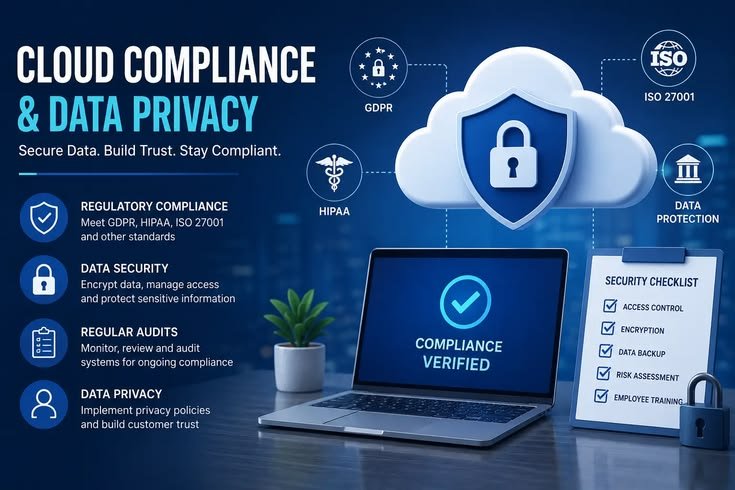
Cloud Security Compliance Explained
Introduction
As businesses increasingly move their applications, databases, and sensitive information to the cloud, security and regulatory compliance have become critical priorities. Organizations are responsible not only for protecting their cloud environments from cyber threats but also for ensuring that customer data is handled according to legal and industry standards.
Cloud security compliance refers to following laws, regulations, industry standards, and security frameworks that govern how organizations collect, store, process, transmit, and protect data in cloud environments. Compliance helps businesses reduce security risks, protect customer privacy, avoid legal penalties, and build trust with clients and partners.
Many industries, including healthcare, finance, government, education, and e-commerce, have strict compliance requirements. Organizations that fail to meet these requirements may face financial penalties, legal action, operational disruptions, and damage to their reputation.
This guide explains cloud security compliance, why it matters, common compliance standards, challenges, and best practices for maintaining a secure and compliant cloud environment.
What Is Cloud Security Compliance?
Cloud security compliance is the process of ensuring that cloud systems, applications, and data follow applicable laws, regulations, and industry standards.
Compliance includes:
- Protecting sensitive information
- Managing user access
- Encrypting data
- Monitoring cloud activity
- Maintaining security controls
- Keeping audit records
- Responding to security incidents
Compliance is an ongoing process rather than a one-time task.
Why Cloud Security Compliance Is Important
Compliance provides several important benefits.
Protects Sensitive Data
Compliance frameworks require businesses to safeguard customer, employee, and financial information.
Reduces Cybersecurity Risks
Security controls reduce the likelihood of data breaches and unauthorized access.
Meets Legal Requirements
Organizations avoid fines and legal consequences by following applicable regulations.
Builds Customer Trust
Customers are more likely to work with companies that protect their information responsibly.
Supports Business Continuity
Compliance encourages strong backup, disaster recovery, and incident response practices.
Improves Risk Management
Organizations identify and address security weaknesses before they become serious problems.
Shared Responsibility in Cloud Compliance
Cloud security compliance follows a shared responsibility model.
Cloud Provider Responsibilities
Cloud providers generally manage:
- Physical data centers
- Hardware
- Network infrastructure
- Core cloud services
- Physical security
Customer Responsibilities
Customers are responsible for:
- User accounts
- Data protection
- Identity management
- Application security
- Access controls
- Compliance configurations
Understanding these responsibilities is essential for maintaining compliance.
Common Cloud Security Compliance Standards
Many organizations follow internationally recognized compliance frameworks.
GDPR (General Data Protection Regulation)
GDPR protects the personal information of individuals in the European Union.
Organizations must:
- Collect data lawfully
- Protect personal information
- Report certain data breaches
- Respect user privacy rights
Businesses serving EU customers should understand GDPR requirements.
HIPAA (Health Insurance Portability and Accountability Act)
HIPAA applies to healthcare organizations in the United States.
It protects:
- Patient records
- Medical information
- Health insurance data
Healthcare providers using cloud services must secure electronic health information.
PCI DSS (Payment Card Industry Data Security Standard)
PCI DSS applies to organizations that process payment card information.
Requirements include:
- Strong access controls
- Network security
- Encryption
- Continuous monitoring
Compliance reduces payment fraud risks.
ISO/IEC 27001
ISO 27001 is an international information security management standard.
It provides guidance for:
- Risk management
- Security policies
- Access controls
- Incident response
- Continuous improvement
Many organizations adopt ISO 27001 to strengthen information security.
SOC 2
SOC 2 evaluates how service providers manage customer data.
It focuses on:
- Security
- Availability
- Processing integrity
- Confidentiality
- Privacy
Many cloud providers obtain SOC 2 reports to demonstrate security practices.
Key Components of Cloud Compliance
Cloud compliance includes multiple security controls.
Identity and Access Management (IAM)
Organizations should:
- Control user access
- Apply least privilege
- Enable multi-factor authentication
- Review permissions regularly
Data Encryption
Sensitive information should be encrypted:
- At rest
- In transit
Encryption protects information even if unauthorized access occurs.
Logging and Monitoring
Organizations should monitor:
- User activity
- Login attempts
- Configuration changes
- Security events
- Administrative actions
Logs support investigations and compliance audits.
Backup and Disaster Recovery
Compliance often requires:
- Regular backups
- Recovery testing
- Business continuity planning
These measures reduce operational disruption.
Vulnerability Management
Businesses should regularly:
- Scan systems
- Install updates
- Fix security weaknesses
- Test cloud environments
Challenges of Cloud Security Compliance
Maintaining compliance can be difficult.
Common challenges include:
- Constantly changing regulations
- Multi-cloud environments
- Complex access management
- Data privacy concerns
- Limited security expertise
- Third-party risks
- Misconfigured cloud resources
Organizations should review compliance regularly.
Best Practices for Cloud Security Compliance
Businesses can improve compliance by following these best practices.
Understand Applicable Regulations
Identify which regulations apply to your industry and customers.
Choose a Compliant Cloud Provider
Select providers that support recognized security certifications.
Enable Multi-Factor Authentication
Require MFA for privileged accounts.
Encrypt Sensitive Information
Protect stored and transmitted data.
Apply Least Privilege Access
Limit user permissions to necessary resources.
Monitor Cloud Activity
Continuously review security logs and user behavior.
Perform Regular Security Audits
Audits identify weaknesses before compliance issues occur.
Train Employees
Educate staff about:
- Security policies
- Data privacy
- Phishing awareness
- Password security
Keep Documentation Updated
Maintain documentation for:
- Security policies
- Access controls
- Incident response
- Backup procedures
- Audit records
Test Incident Response Plans
Practice responding to security incidents to improve preparedness.
Common Cloud Compliance Mistakes
Organizations should avoid these common mistakes.
- Ignoring security updates
- Weak password policies
- Excessive user permissions
- Missing audit logs
- Poor documentation
- Unencrypted sensitive data
- Infrequent security reviews
- Lack of employee training
- Not testing backups
- Assuming compliance is automatic
Avoiding these mistakes strengthens both security and compliance.
Benefits of Maintaining Cloud Compliance
Strong compliance provides many long-term advantages.
These include:
- Improved cybersecurity
- Better customer confidence
- Reduced legal risk
- Easier regulatory audits
- Stronger business reputation
- Faster incident response
- Better operational efficiency
- Reduced financial penalties
- Enhanced data protection
- Long-term business stability
Future of Cloud Security Compliance
Cloud compliance continues to evolve alongside technology.
Future trends include:
- Artificial intelligence for compliance monitoring
- Automated compliance reporting
- Zero Trust security frameworks
- Continuous compliance assessments
- Stronger privacy regulations
- Advanced cloud monitoring tools
Organizations should remain informed about changing regulatory requirements.
Conclusion
Cloud security compliance is essential for protecting sensitive information, meeting legal requirements, and maintaining customer trust. Compliance is not limited to passing audits; it involves building secure cloud environments through strong access controls, encryption, continuous monitoring, regular risk assessments, employee training, and ongoing policy reviews. Organizations that treat compliance as a continuous process are better prepared to prevent security incidents, reduce operational risks, and support long-term business growth in an increasingly cloud-driven world.
Frequently Asked Questions (FAQ)
1. What is cloud security compliance?
Cloud security compliance is the process of following laws, regulations, and industry standards to protect data and cloud systems.
2. Why is cloud compliance important?
It helps organizations protect sensitive information, meet legal requirements, reduce cyber risks, and build customer trust.
3. What is the shared responsibility model?
It is a model where the cloud provider secures the infrastructure while customers are responsible for protecting their data, applications, and user accounts.
4. What are the most common cloud compliance standards?
Common standards include GDPR, HIPAA, PCI DSS, ISO/IEC 27001, and SOC 2.
5. How does encryption support compliance?
Encryption protects sensitive data by making it unreadable to unauthorized users during storage and transmission.
6. Why are security audits important?
Security audits identify vulnerabilities, verify compliance, and improve overall cloud security.
7. What is the principle of least privilege?
It means giving users only the minimum permissions needed to perform their assigned tasks.
8. Can small businesses benefit from cloud compliance?
Yes. Compliance improves security, customer confidence, and business credibility regardless of company size.
9. How often should cloud compliance be reviewed?
Organizations should review compliance regularly, especially after regulatory updates, security incidents, or major infrastructure changes.
10. How can businesses maintain cloud security compliance?
Businesses should follow applicable regulations, use strong access controls, encrypt data, monitor cloud environments, train employees, conduct regular audits, and maintain updated security documentation.